


Slip Meaning in English
The word slip in English has several meanings depending on the context. As a verb, it commonly means to slide accidentally, lose balance, or move smoothly and quietly. For example, “Be careful not to slip on the wet floor.” It can also mean to make a small mistake, such as in the phrase “a slip of the tongue.”
As a noun, slip can refer to a small piece of paper, an undergarment worn under a dress, or a minor error. Because of its multiple meanings, understanding the sentence context is important when interpreting the word “slip.”
Paper Slip Meaning
A paper slip refers to a small piece of paper used for writing short information. It can serve many purposes, such as notes, reminders, receipts, bank transactions, or official documents.
For example:
A teacher may hand out a paper slip with exam instructions.
A bank may issue a deposit slip for transactions.
A delivery service may provide a confirmation slip.
Paper slips are usually small, easy to handle, and contain brief but important information.
Slip Meaning in Farsi
In Farsi (Persian), the meaning of slip depends on context:
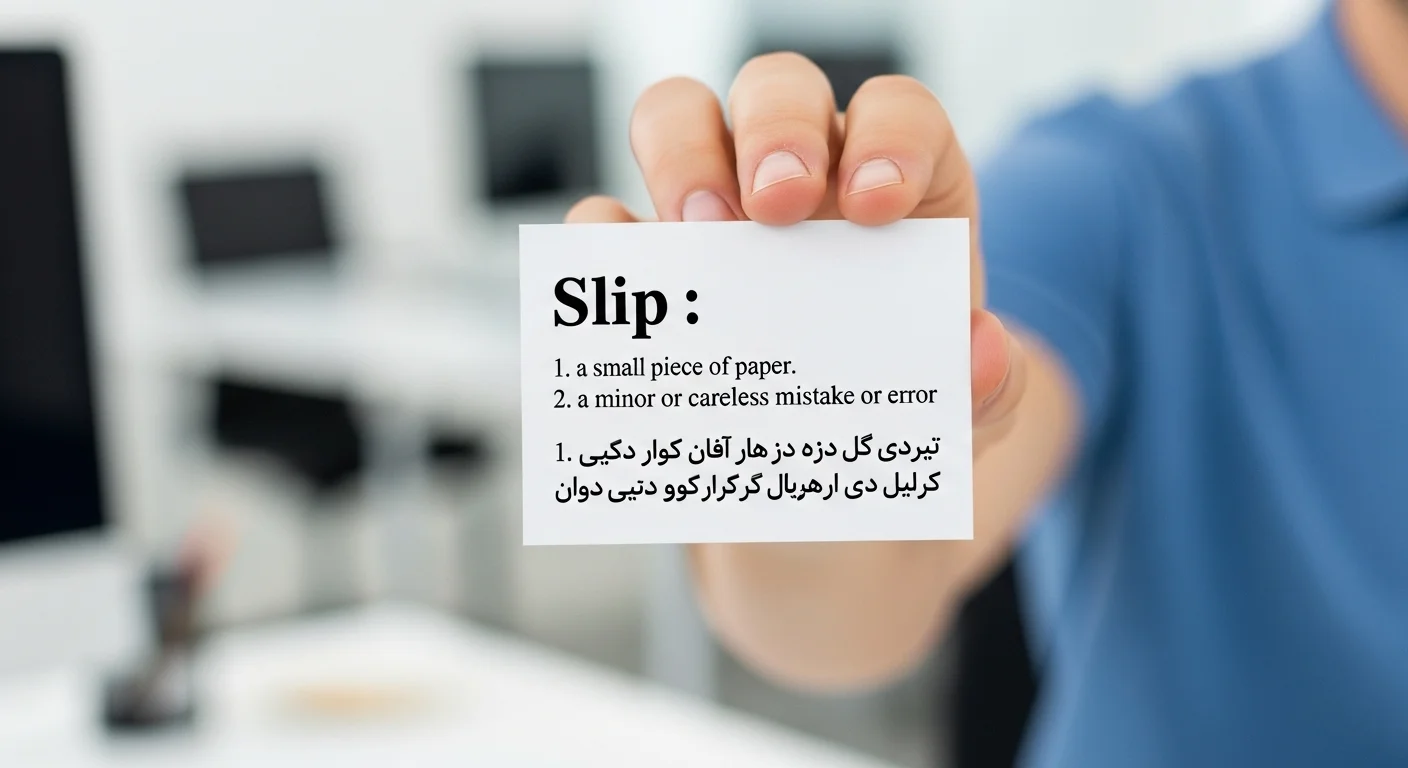
As a verb (to slide or lose balance): سر خوردن (sar khordan)
As a mistake (slip of the tongue): اشتباه لپی (eshtebah-e lapi)
As a small paper: برگه کوچک (bargeh-ye kuchak)
As an undergarment (clothing slip): زیرپیراهنی زنانه
Since “slip” has multiple meanings in English, the correct Farsi translation depends on how it is used in the sentence.
Slip Meaning in Chat
In online chat or texting, slip can have different informal meanings. It may refer to:
A typing mistake (for example, “Oops, that was a slip.”)
Accidentally revealing information (“He let it slip.”)
Sometimes slang usage depending on the conversation
In digital communication, “slip” usually relates to a small error or something said unintentionally.
Receipt Slip Meaning
A receipt slip is a printed document given after a purchase or transaction. It serves as proof of payment and includes details such as:
Date of purchase
Items bought
Total amount paid
Payment method
Receipt slips are important for returns, exchanges, refunds, or financial record-keeping. They are commonly issued in stores, restaurants, and online orders (digital version).
Payment Slip Meaning
A payment slip is a document used to make or confirm a payment. It may be issued by banks, utility companies, or institutions. Payment slips usually include:
Account number
Payment amount
Due date
Reference details
For example, students may receive a payment slip for tuition fees, or customers may get a utility payment slip for electricity bills. It ensures accurate and traceable transactions.
Slipped Off Meaning
Slipped off is the past form of the phrasal verb “slip off.” It can mean:
To remove something quietly or easily
“She slipped off her shoes.”
To leave quietly without being noticed
“He slipped off during the meeting.”
To slide off accidentally
“The ring slipped off her finger.”
The meaning depends on the sentence context.
Slip Meaning Past Tense
The past tense of slip is slipped.
Examples:
“I slipped on the ice yesterday.”
“He slipped the note into her bag.”
The past participle is also slipped.
Slip is an irregular-looking verb, but it actually follows the regular pattern by adding -ed to form the past tense.
What Does “Slip Meaning” Mean in Chat or Text?
In online chats, “slip” is more than just a word about falling or accidents. Its meaning depends on the context, tone, and platform. Here’s the breakdown:
Making a Mistake or Forgetting Something
Most commonly, “slip” refers to accidentally doing something wrong or saying something unintentionally.
Example: “That comment was a slip, didn’t mean to offend.”
Here, “slip” is short for a slip-up, meaning a minor mistake.
Sliding Into DMs or Messages
In social media and dating app culture, “slip” can mean sending a private message, often sneakily or casually.
Example: “He slipped into my DMs last night.”
Slang for Moving Quietly or Escaping
Some users use “slip” to describe leaving a conversation or situation unnoticed.
Example: “I had to slip out of the chat before things got awkward.”
A Quick Origin History
The use of “slip” as slang comes from its literal meaning: to slide or accidentally lose footing. Over time, internet culture expanded its usage:
Early 2010s: “slip-up” became common in texting to admit small mistakes.
Mid-2010s: Social media added the DM context.
Today: It’s versatile, used across texting, gaming chats, and forums.
How People Use “Slip Meaning” in Real Conversations
The way slip is used depends heavily on the platform:
Platforms:
Texting: Often refers to a minor mistake.
“Oops, that was a slip, my bad.”
Instagram/Snapchat: Can mean sending a private message.
“He slipped into my Snap yesterday.”
Discord/Gaming: Might indicate quietly leaving a conversation or avoiding attention.
“I slipped before the argument started.”
Dating Apps: Usually about sliding into DMs or casual messaging.
“Did you slip into their DMs yet?”
Forums: Could indicate sharing a post or message without drawing attention.
When It’s Appropriate vs. Awkward
Appropriate: Casual chats with friends, playful DMs, admitting small mistakes.
Awkward: Formal or professional conversations. Using “slip” in emails or work chats might confuse readers.
Pro Tip: Tone matters. If you’re texting someone you don’t know well, “slip” might sound too casual or ambiguous.
Real-Life Examples of “Slip Meaning” in Text Messages
Here are some relatable examples showing slip in context:
Admitting a Mistake
Friend 1: “Did you forget the meeting?”
Friend 2: “Yeah, total slip on my part.”
Sliding into DMs
Friend 1: “Did he reach out?”
Friend 2: “Yeah, he slipped into my DMs last night.”
Leaving a Chat Quietly
Friend 1: “Where did Alex go?”
Friend 2: “He slipped before the drama started.”
Funny/Relatable Slip
Friend 1: “I accidentally replied all to the email…”
Friend 2: “Classic slip moment.”
Each example shows how context changes the meaning—a small mistake, a secret message, or quietly leaving a conversation.
Common Mistakes & Misunderstandings
Even experienced texters sometimes get slip meaning wrong:
Confusing with American Sign Language (ASL)
“Slip” in ASL has a literal gesture but doesn’t carry the slang meanings.
Using in the Wrong Context
Saying “I slipped in the meeting” to mean sending a DM is incorrect.
Tone Misinterpretations
Some people might think “slip” is negative or dramatic. Usually, it’s casual and harmless.
Remember: When in doubt, context is king.
Related Slangs & Abbreviations
Here are some similar chat terms you might see:
Slip-up – Directly related, meaning a minor mistake.
Slide – Often used for sliding into DMs, similar to “slip” in messaging.
Oops – Casual exclamation for small mistakes.
Ghost – Leaving a conversation quietly, overlaps with “slip” in some contexts.
Internal Linking Opportunities: If you’re creating a site about slang, you can link “slide meaning,” “oops meaning,” or “ghost meaning” articles for SEO synergy.