
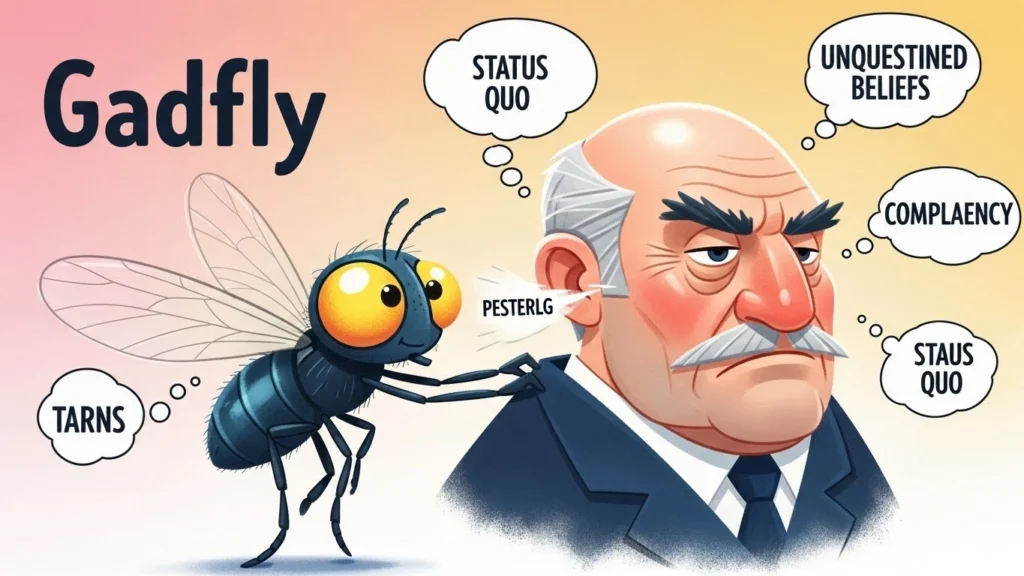

Gadfly Meaning Political
In politics, a gadfly is a person who critically challenges authority, policies, or social norms. They provoke debate, question decisions, and push leaders to rethink their actions. Political gadflies are often seen as troublemakers but play a key role in holding governments accountable and encouraging transparency.
Gadfly Meaning Socrates
The term gadfly is famously associated with Socrates, who described himself as a gadfly to the state of Athens. Just as a gadfly stings a horse to keep it alert, Socrates aimed to stimulate citizens and leaders to self-examination and critical thinking, challenging complacency and ignorance.
Gadfly Meaning in English
In English, a gadfly has two main meanings:
A person who provokes or annoys others to elicit change or reflection.
A biting fly or insect that irritates livestock.
Metaphorically, it is often used for individuals who provoke thought, debate, or action.
Gadfly Synonym
Some common synonyms for gadfly in the metaphorical sense include:
Critic
Provocateur
Agitator
Challenger
Questioner
Instigator
These terms describe people who challenge the status quo or stimulate debate.
Social Gadfly Meaning
A social gadfly is a person who actively questions social norms, traditions, or popular opinions to encourage reflection and reform. Social gadflies can be writers, activists, or thinkers who use their influence to push society toward change.
Gadfly Pronunciation
Gadfly is pronounced as /ˈɡæd.flaɪ/. The first syllable “gad” rhymes with “mad,” and the second syllable “fly” is pronounced like the insect.
Gadfly Insect
A gadfly is also a type of biting fly known to irritate livestock, especially horses and cattle. These insects are known for their painful bites and persistent buzzing, which can disturb and stress animals.
Gadfly Bite
A gadfly bite is a painful, itchy bite caused by the gadfly insect. While usually not dangerous, these bites can cause discomfort, swelling, and irritation, especially for animals like horses and cattle. In some cases, repeated bites can lead to infections or allergic reactions.
What Does “Gadfly” Mean in Chat or Text?
A gadfly is someone who provokes others, challenges ideas, or stirs up discussions, usually in a way that is persistent and sometimes annoying—but often with a purpose. The term comes from the literal insect that bites and irritates livestock, which is a pretty accurate metaphor for how gadflies behave in conversation.
Different Meanings Based on Context
Classic meaning: Someone who persistently questions or challenges authority or conventional thinking.
Casual or playful chat meaning: A friend who teases or provokes you just to get a reaction.
Online usage: On forums, Discord, or Twitter, a gadfly might be the person who always comments something provocative to spark debate.
Brief History
The word gadfly dates back to ancient Greece. Socrates was famously called a gadfly because he constantly questioned and challenged the Athenian government, pushing citizens to think critically. Over time, it became a general term for anyone who provokes thought or conversation—sometimes annoyingly, sometimes helpfully.
How People Use “Gadfly” in Real Conversations
Platforms
You’ll see gadfly pop up in:
Texting: “Stop being such a gadfly, I’m trying to eat!”
Instagram/Twitter captions or comments: Describing someone’s provocative posts.
Discord or gaming chats: For the player who always questions strategies or teases teammates.
Forums & Reddit: Users who challenge popular opinions or poke fun at others.
Professional discussions: Sometimes used in work emails or LinkedIn posts to describe a critical thinker or someone who pushes back constructively.

When It’s Appropriate vs. Awkward
Appropriate: Using gadfly to describe someone in a playful or intellectual context.
Awkward: Calling someone a gadfly sarcastically in a sensitive situation—they may not understand the nuance.
Tip: Gadfly is often positive in an intellectual sense but can be negative if used to label someone as irritating.

Real-Life Examples of “Gadfly” in Text Messages
Here are some short chat-style examples to make it crystal clear:
Texting a friend
Friend: “Why are you always asking weird questions?”
You: “I’m just a gadfly keeping you on your toes!”
Explanation: Playful self-description for someone who provokes thought or teases.Discord gaming
Player1: “We should attack now.”
Player2: “Hmm… I think that’s risky.”
Player3: “Gadfly alert! Always second-guessing.”
Explanation: Light teasing for someone who challenges ideas.Reddit discussion
User1: “I think pineapple pizza is amazing.”
User2: “Here comes the gadfly to stir the debate!”
Explanation: Used humorously for someone about to provoke discussion.Professional context
Colleague: “Jane’s always questioning our methods.”
You: “She’s a real gadfly, but it makes us better.”
Explanation: Positive usage highlighting someone’s critical thinking skills.
Common Mistakes & Misunderstandings
Even though gadfly seems simple, people often misuse it:
Confusing it with gossip or troll behavior: Gadflies provoke thought, not just drama.
Misinterpreting tone: Calling someone a gadfly can be positive or negative depending on context.
Assuming it’s outdated slang: While historical, gadfly is still used in modern chat and social discussions.
Mixing with American Sign Language or emoji meanings: The word has no hidden emoji or ASL abbreviation—use it literally.
Related Slangs & Abbreviations
If you like understanding terms like gadfly, here are some related chat terms:
Troll – Provokes others online but usually just for amusement, not constructive debate.
Shitposter – Someone who posts humorous, annoying, or absurd content online.
Debater – A friendly term for someone who challenges ideas logically.
Contrarian – Someone who takes the opposite side just to provoke thought.
Provocateur – Someone who deliberately sparks controversy or debate.
Internal linking opportunities: “gadfly meaning” can link to pages about “troll meaning,” “contrarian in chat,” or “online debate slang.”