
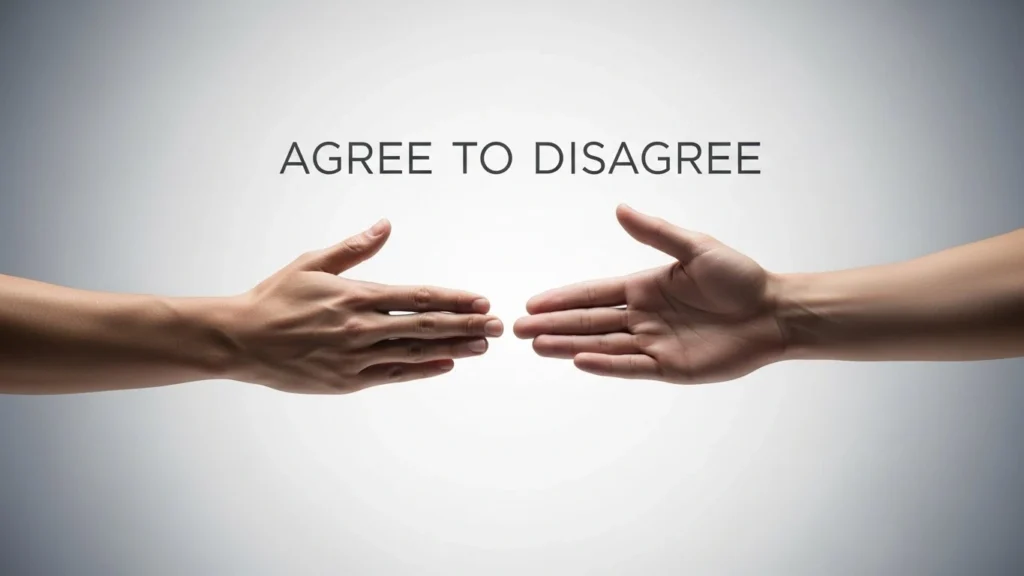
What Does “Agree to Disagree” Meaning in Chat or Text?
At its core, agree to disagree is a way of acknowledging a difference of opinion without trying to force someone to change their mind. It’s essentially a verbal truce.
Definition: To accept that you and another person have differing opinions and to stop arguing about it.
Contextual meaning:
In friendly chats, it’s a polite way to end a debate.
In online forums or social media, it can prevent comment wars.
In dating or personal messages, it can maintain respect while disagreeing.
Origin: The phrase comes from 18th-century political and religious debates, where opponents realized some disagreements weren’t resolvable and agreed to tolerate opposing views. Over time, it became common in everyday English, and now it’s widely used in texting and chat culture.
How People Use “Agree to Disagree Meaning” in Real Conversations
Understanding where and how to use agree to disagree is key. While it’s polite, using it incorrectly can feel dismissive or awkward.
Platforms:
Texting: Quick way to end an argument with friends or family.
Instagram & Facebook comments: Avoids long comment threads and prevents trolling.
Snapchat & WhatsApp: Keeps group chats drama-free.
Discord & Gaming chats: Stops heated discussions over games, strategy, or fandom debates.
Dating apps: Helps maintain respect when opinions clash.
Forums & Reddit threads: Commonly used to close disagreements in community discussions.
Appropriate use:
When both parties understand the disagreement and are willing to move on.
When the conversation could escalate unnecessarily.
Awkward use:
If someone isn’t ready to let go, it can come across as dismissive.
Using it repeatedly in the same conversation may feel like avoiding discussion.
Pro Tip: Pair agree to disagree with a neutral tone to avoid sounding passive-aggressive.

Real-Life Examples of “Agree to Disagree Meaning” in Text Messages
Here are some chat-style examples to see how it works in practice:
Example 1:
Alex: “Pineapple belongs on pizza, it’s the best!”
Jamie: “No way, that’s a crime against pizza.”
Alex: “Haha okay, let’s agree to disagree.”
Explanation: They acknowledge the difference without continuing the argument.
Example 2:
Sam: “I think this new game update is terrible.”
Riley: “I love it though, best update ever.”
Sam: “Guess we’ll just agree to disagree.”
Explanation: Both keep their opinions while avoiding further debate.
Example 3:
Taylor: “I’m a cat person.”
Morgan: “Dogs are obviously better.”
Taylor: “Fair enough, we can agree to disagree.”
Explanation: Respectful ending to a friendly disagreement.
Common Mistakes & Misunderstandings
Even a simple phrase like agree to disagree meaning can be misused. Here are the most common mistakes:
Confusing it with ASL or slang acronyms: Some people see “ATD” in chats and might not realize it means agree to disagree.
Using it in a hostile context: It can come off as sarcastic or dismissive if the conversation is tense.
Overusing it: Constantly saying it may suggest you’re avoiding actual discussion.
Misreading tone: Texting lacks vocal cues, so readers might think you’re rude.
Tip: Use it sparingly and always with context that makes your intentions clear.
Related Slangs & Abbreviations
Here are some similar phrases and abbreviations that are useful in online chats:
TL;DR (Too Long; Didn’t Read): Summarizes long arguments.
IMHO (In My Humble Opinion): Politely shares an opinion.
FYI (For Your Information): Neutral way to provide facts.
Agree? / Disagree?: Quick way to prompt discussion.
ATD (Agree to Disagree): Shorthand version used in texting.
These terms often appear alongside agree to disagree meaning in modern chat culture, making your conversations smoother and clearer.